
Source: The Liber de Servis of Marmoutier
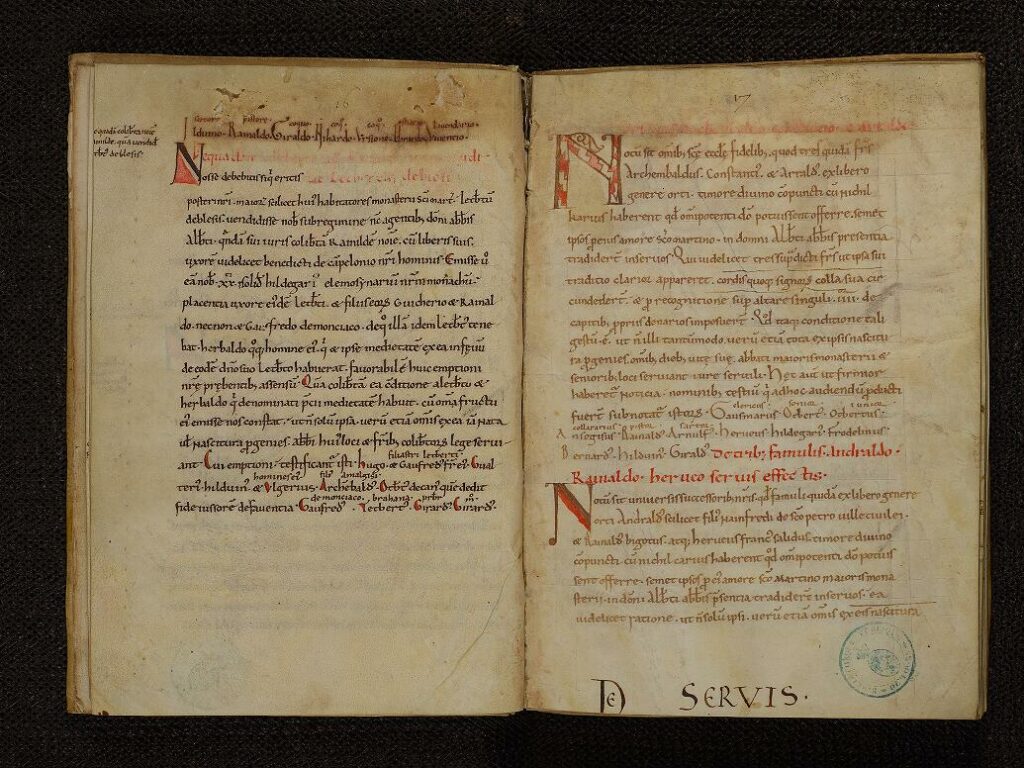
Around 1070 C.E., the influential monastery of Marmoutier in Western France complied over a hundred documents relating to its unfree dependants into a single volume, to which further documents were added in the following decades. This cartulary, known as the Liber de Servis, is a unique document from medieval Western Europe, conserving only documents related to unfree people, rather than more common subjects like land ownership or tax exemptions. (The original manuscript can be viewed online here).
The people in the Liber de Servis are referred to by a variety of terms in the original Latin, which have been retained in the translation below; it remains a matter of debate among historians whether these people should be described as slaves, serfs or with a more generic term such as unfree. The most common terms used are servus (slave/serf/servant), ancilla (female slave/servant) and colibertus (m)/coliberta (f) (a person of nominally higher status than a servus, but who was still legally unfree). However, all persons who were subject to the documents were legally owned by the monastery of Marmoutier. The Liber de Servis includes records of donations, sales, manumissions and disputes over unfree people, as well as a large number of acts by which people gifted themselves and their families into the monastery’s servitude. In many of these documents, the four denarii (silver pennies), which unfree dependents were required to pay to the monks every year as recognition of their status, play a key symbolic role in confirming their status.
The texts translated here were chosen to provide a sample of the variety of documents in the Liber de Servis, but the majority of documents are records of gifts of unfree people, either by local lords (as in no. 5) or by the people themselves (as in nos. 3 and 41). Although few are precisely dated, most of the documents date from the reigns of abbots Albert (1032-64) or Bartholomew (1064-84). The titles of the documents were added by the compilers of the Liber de Servis and written in red ink, to allow particular documents to be found by quickly skimming the headings.
Translated from Latin by Niall Ó Súilleabháin. André Salmon (ed.), with introduction and appendix by Charles L. Grandmaison, Le Livre des Serfs de Marmoutier (Tours : Imprimerie Ladevèze, 1864), nos 3, 5, 28, 41, 49, 106. This contribution CC BY-NC-ND 4.0.
No. 3: About Bertran Agnellus who was made a servus
Let it be known that Bertran Agnellus became a servus of Saint Martin, for which we allowed him to buy a certain house in our burg, which he bought from a certain servus of ours named Hademar. He and his wife Ermentrude and their son Rigald came into our meeting-chamber and there, following the custom, placed 4 denarii on their heads. All three handed themselves and all of their descendants over completely to our prior, Lord Odo, to be servi,. Witnesses to these things: Odo the cook, Girard the cook, Herveus the cook, Ingelbert the mayor, Gui the mayor, Walter of Chinzy, Esgared son of Walter the porter.
No. 5: About ten servi living at Le Loroux, which were given or sold to us by Ainard of St-Maur
Let it be known to our brothers, the monks of Marmoutier, that Ainard of St-Maur came into our chapter-house and gave to Saint Martin and to us ten servi, comprising men and women living at Le Loroux, which he held of Haimeric of Fagia. Although he did not have them by inheritance, nor could any of his kin make a claim upon them by law, he promised nevertheless that he made this concession and that it was proper in every way, and he discharged them to us without any claims upon them. He also had here a certain grandson, called in the same way Ainard, who also consented in the same way. And when he [Ainard] had accepted the beneficium[1] with him [Ainard the grandson], with his hands he gave to the abbot Lord Bartholomew one of the aforesaid servi, named Bernard, who alone was present then, and through him the rest [of the servi were also given]. Witnesses to these things: Warin son of Rainbald, Archembald the cellarer, Walter son of Walter, Geoffrey the shoemaker, Otger the carpenter, Josbert the cook, Hilduin son of Durand.
[1] The beneficium was a sort of VIP-club for major donors to monasteries.
No. 28: About Gerlenda, the coliberta sold to us by Geoffrey
You ought to know, if you are future residents of our monastery of St-Martin of Marmoutier, that a certain Geoffrey of Blois, who was a man of Viscount Gilduin and son of Fulbert the Red, sold to us for 12 solidii[1], given by the hand of our brother lord Hildegard the almoner, a certain coliberta named Gerlenda, the daughter of certain people living on our land at Gilliacum, that is Gumbald the forester and Guitbergis. Our purchase is agreed under the condition that not only she, but all children who will be born of her, should serve the poor in the alms-house or anywhere where she is ordered to be. And so that she can remain under this servitude for posterity, Geoffrey gave guarantors to us for her from his lord, the aforesaid Viscount Gilduin, in order that all claims arising from him towards us about her should be settled. For these guarantees as well as for the sale, these witnesses are named: Rainard the cousin of that same Geoffrey; Archembald of Françay; Rainerius, servant of St-Martin, Theirry son of Hugh of Avazai; Gilduin Bocellus; Arrald the cleric; Otbert the deacon; Gervais son of Lancelin.
[1] A solidus was a monetary unit of account, worth 12 silver denarii (pennies). Thus 12 solidii was the equivalent in cash terms to 144 denarii.
No. 41: About Hildgod the servus
Let it be known to all the faithful of the holy Church of God that a certain servant of our household, descended from free lineage, named Hildgod was compelled by divine fear. Having nothing more valuable which he could offer to almighty God, he gave himself as a servus, in the presence of the lord abbot Albert, for his love of Saint Martin. Thereby Hildgod, so that his donation could be more clearly apparent, hung a rope as a sign around his neck and placed 4 denarii from his own head upon the altar, as recognition [of his status]. So it was that by this act, not only he, but all children that will be born of him, shall serve for all the days of his life the abbots of Marmoutier and the lords of that place with the duties of a servus. In order that this document be held more firmly, the names of the witnesses who were assembled at this hearing are recorded below. Gausmar the cleric; Otbert the elder; Otbert the younger; Ansegisus the cellarer; Herveus; Rainald the miller; Arnulf the tailor; Hildegar; Frodelinus; Bernard; Hilduin.
No. 49: About Raoul the servus who was made free
Posterity should know that the lord abbot Albert and the brothers of Marmoutier freed and ordained as a cleric a certain servus of Saint Martin, named Raoul. By this it was reasoned and agreed that he should never withdraw himself from the service of Saint Martin into that of passing strangers, but he should be subjected to the monks in all of his servitude, as before. If he should turn himself away from our service, let him be returned as a fugitive and revert back to a servus, wherever he may have fled. Moreover, so that he should behave himself chastely and his modesty be seen: if he is promoted to higher ecclesiastical orders[1], he should never, having been enticed by foul desire and deceived by nefarious temerity, be associated with women in illicit dealings, as many [clerics] are, who lose face and are openly coupled, contrary to the law and to divine teaching, in marriages to wives guilty of sacrilege and adultery. But if he remains a cleric, and he takes a single wife, his offspring (should he have children), along with all of their progeny thereafter, should be Saint Martin’s, dedicated to the servitude to which their father had been bound before he became a cleric. For all of this, he gave as guarantors: Walter, Gerald, Alcher.
[1] In the medieval church, the higher ecclesiastical orders were those of deacon, priest and bishop. The lower ecclesiastical orders, usually referred to simply as clerics, included married men as well as those training for higher orders. All legally unfree people were barred from taking ecclesiastical orders, which necessitated manumission before ordination, as in this case.
No. 106: About Gandelbert the servus and Girberga the ancilla, his wife
You ought to know, if you are future residents of our monastery of St-Martin of Marmoutier, that a certain man of Vendôme, named Gandelbert, who had before been made a servus of Saint Martin of Marmoutier and was ours, married a wife from the same region named Girberga, who also in the same way became our ancilla, having married one of our servi. But when this Gandelbert would not recognise that he was in any way our servus, Lord Odo our prior seized him on the spot and brought him to Marmoutier, where he held him in prison for a long time, until he confessed that he was a servus. And so that he would not deny this a second time, he came into our chapter-house with his wife to recognise their servitude there; they each placed 4 denarii on their heads which the lord abbot then accepted, among these witnesses: Gerald the fisherman, Gerald son of Lambert, Gerald the cook, Odo the cook, Durand the marshal, Peter the cook, Leald the chamberlain, Gerald of Lavardin the servant, Vaslin the cellarer, Drogo of Taven, Humbert of Semitar the servant, Ralph of Semitar.
Discussion Questions
- What were the motivations which inspired these documents to be drawn up? Who did they seek to benefit or protect?
- How much do these documents reveal about the agency of unfree people in eleventh-century France? What factors impacted an unfree persons scope of action?
- Some historians have suggested that becoming a dependent of Maroutier was a sensible, strategic move, bringing with it material wealth, legal protection and the possibility of career advancement. On the basis of these texts, was it advantageous to be an unfree dependent of Marmoutier?
- How did Marmoutier’s status as a religious institution impact its unfree dependents?
Related Primary Sources
- Canon Law Concerning Slave Marriage to Free People
- Geatfled Gives Freedom
- Manumission in Genoa
- Slave Labor and Free Service in Genoa
- Slave Sale Contracts from Genoa
- Visigothic Manumission Charters
Related Secondary Sources
- Dominique Barthelemy, The Serf, the Knight and the Historian, trans. Graham Robert Edwards. Ithaca, NY: Cornell University Press, 2009. Chapters 3-4.
- Paul Fouracre, “Marmoutier and its Serfs in the Eleventh Century,” Transactions of the Royal Historical Society, 6th ser., vol. 15 (2005): 29-49.
- Alice Rio, Slavery After Rome: 500-1100. Oxford: Oxford University Press, 2017.
- Mary Sommar, The Slaves of the Churches: A History. Oxford: Oxford University Press, 2020.
Themes
Agency, Flight, Manumission, Men, Property, Women, Religion, Self-Sale
Recent Comments