
Source: Cantigas de Santa María
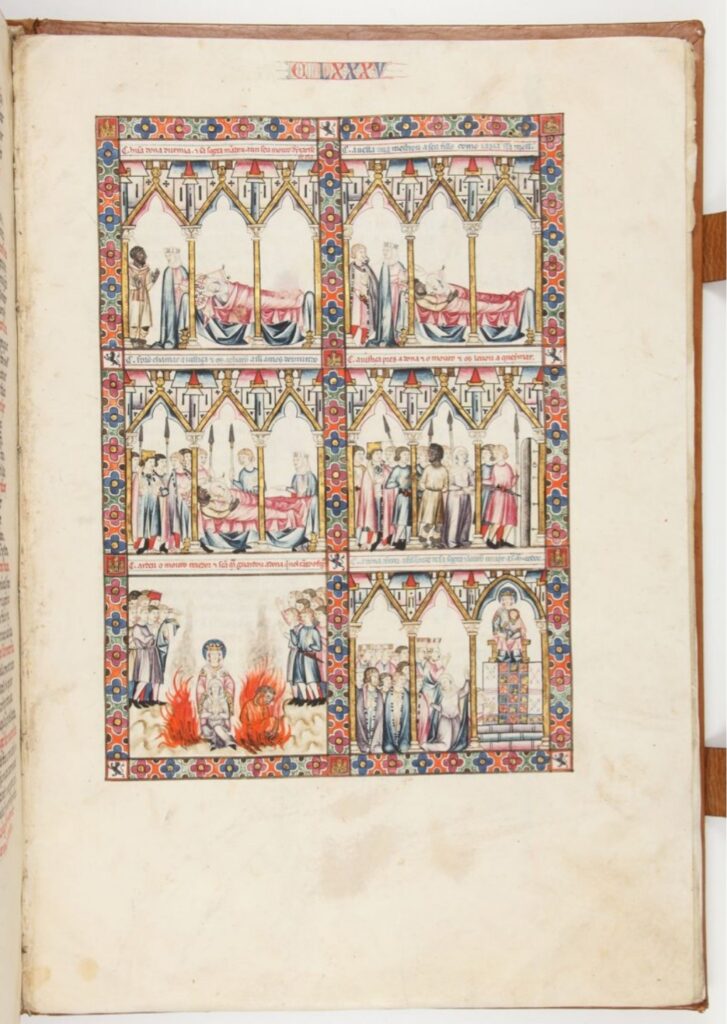
The Cantigas de Santa María, or the Songs of Holy Mary, are thirteenth-century manuscripts that dedicate songs and miracles to the Virgin Mary, replete with exquisite illuminations. Written in Galician-Portuguese, a romance language used for lyric poetry in this period, they were commissioned by King Alfonso X of Castile (r. 1252-1282). Many of these songs were copied from older Iberian and European texts, but many are original to the Cantigas manuscripts Alfonso patronized. Scholars claim that the art of Alfonso’s Cantigas, such as the illuminations of the Códice Rico codex (ca. 1280-1284), display an increasingly hostile perspective on Jews and Muslims within Castile. Regarding religious minorities, the Cantigas frequently cast Muslims, specifically Black Muslims, as unfree and/or enemies of the faith, ascribing to them undesirable characters and traits.
This particular miracle describes how Mary spared a Christian wife a fiery death after her conniving mother-in-law set her up to be found in bed with her enslaved Black Muslim man, termed “un seu mouro/one of her Muslims” in the text. At its core, it is a story about one of the most taboo crimes for the period: extramarital sex with a person of a different religion. However, this miracle also reveals important information about gender, enslavement, and race in the late thirteenth century.
Medieval laws punished Christian women who had sex with non-Christians more harshly than Christian men who did the same—indeed, some law codes prescribed no punishments for Christian men who had sex with non-Christians. This gender imbalance is evident in the Cantigas, for after the husband calls for witnesses to see his wife’s crime, he is allowed to execute her and the Muslim man. It is notable that while the Virgin saves free and unfree, Christian and Muslim elsewhere in the Cantigas, this Muslim, forced to commit a crime by his enslaver, is allowed to burn to death, denied the miracle that saves the young woman. The mother-in-law had sought to kill her son’s wife by weaponizing the gendered responsibility placed on Christian women to maintain communal, social, and religious boundaries with their pure bodies, and it nearly worked.
This implies additional offenses. One is the fair-skinned wife being unfaithful to her fair-skinned husband with a Black man. Regarding enslaved people, it casts them as a moral and religious threat within the household, tapping into fears that the corruption of good Christianness can happen from within the sanctity of the domestic sphere. Such fears mark enslaved people as foreigners to Christian society and ascribe more agency and power to them than they had. Representing the unfree man as Black was not a given for the period. Many different people were trafficked and enslaved in medieval Iberia, and Muslims regardless of class could be and were frequently described as fair-skinned. It is only in later decades that the association of black skin, Islam, and unfreedom coalesced into a trope. In the context of this miracle, however, its creators capitalized upon the shockingness of the staged allegations in both racial and religious ways, showing the changing stereotypes and perceptions regarding slavery in the period.
Contribution by Alexandra Montero Peters. Translation from Gallego-Portuguese by Kathleen Kulp-Hill, Songs of Holy Mary of Alfonso X, The Wise: A Translation of the Cantigas de Santa María (Tempe: Arizona Center for Medieval and Renaissance Studies, 2000), 222-223. This contribution CC BY-NC-ND 4.0.
Cantiga 186
This is how Holy Mary saved from the fire a woman whom they were trying to burn.
The Holy Virgin will rescue from peril the one who firmly believes in Her.
Concerning this, I wish to recount a miracle which Holy Mary performed to rescue a lady who would have burned if She who is powerful had not come to her aid.
This lady was happily married to a husband she loved above all things, and she always dedicated herself to serving Holy Mary.
Her husband loved her above all else, but her mother-in-law had great ill will toward her and plotted a terrible death for her, as I shall tell you now.
One day when the mother-in-law found her sleeping alone, she sent to a Muslim[1] of hers to lie with her. When he lay down, she went to her son and said: “Come here.
“If you saw your wife, whom you loved more than yourself, as I just did, with a Muslim beside her in bed, I imagine it would grieve you greatly.”
When he heard this, he was very disturbed. His mother took him by the hand and led him to the place and said to him: “See what your wife is up to!”
He wanted to kill her on the spot, but his mother said to him: “No, do not do it, but inform the magistrate, and you will see that he will give you justice.”
He called the magistrate to come, along with many others, upon my word. They saw the lady and the Muslim sleeping in the same bed and said: “What will become
“of this woman who does such a vile thing, for she has forgotten God and the world and honor and committed a low and shameful deed? For this she will burn in the fire, for she deserves it.”
And so, according to what I learned of the matter, they seized the lady, who was greatly dismayed when she saw herself caught with that infidel. She cried: “Oh, My Lady, Holy Virgin Mary,
“please help me, for I have great need, for never was a woman in greater trouble. However, I believe that your mercy will never fail anyone who believes in you.”
As she was saying this, they quickly took the lady to a large square, along with the Muslim, who was black as pitch. The people
ran there in haste and lit a fire, larger than you ever saw, all around them. The false, treacherous Muslim burned, but the lady remained like one who is
inside a room, for she felt the fire not at all. The people saw another Lady beside her and heard Her speak, but later they could find no trace of Her.
In this way, the Muslim burned until not a single sign of him remained, and the lady was spared because of that One who will save us.
When she had come out of the fire, the faithful lady told that the Mother of God Immanuel had delivered her from it. That Lady had performed a beautiful miracle and will perform many more.
[1] Kulp-Hill’s English translation gives “Moorish servant” for mouro, but the word Moor is an outdated and problematic term. Also, while the word servant appears elsewhere in the Cantigas and is often synonymous with “slave,” in this case I have chosen to alter Kulp-Hill’s translation to more faithfully capture the source’s language.
Discussion Questions
- How would you describe the relationship between the text and illumination of this miracle? Do you learn new things from one that you would not have from the other?
- Why do you think this crime was punished publicly, and why was the miracle done publicly? Furthermore, comment on the public nature of musical performance, as this miracle was set to song and sung at court and elsewhere.
- How is the enslaved Muslim man painted, and how does his representation communicate his class and lack of agency?
Related Primary Sources
- Christian Capture of Muslim Captives and Slaves in the Thirteenth-Century Crown or Realms of Aragon
- Concerning Sellers of Male and Female Slaves
- Criminal Trials of Slaves in Venice
- Initial Q from the Vidal Mayor: Two Soldiers Leading Two Slaves before a King
Related Secondary Sources
- Patton, Pamela. “What Did Medieval Slavery Look Like? Color, Race, and Unfreedom in Later Medieval Iberia.” Speculum 97, no. 3 (2022): 649–697.
- Peters, Alexandra Montero. “Race, Chess, and Thirteenth-century Court Culture in the Western Mediterranean.” Medieval Encounters, forthcoming in 2026.
- Snow, Joseph T. The Poetry of Alfonso X: An Annotated Critical Bibliography (1278–2010). Woodbridge: Tamesis, 2012.
Recent Comments